A Timeless Journey Through Ancient Luxor's Wonders
In March of 2023, my wife and I eagerly embarked on a long-awaited exploration of Egypt, focusing on the wonders of Luxor and an enchanting Nile cruise. Egypt, a country rich in culture and history, had always been on our travel list. Our comprehensive two-week tour included visits to Cairo, Giza, Luxor, Edfu, Aswan, and Sharm El-Sheikh, as well as iconic sites such as the Great Pyramids, the Sphinx, Karnak, and the Valley of the Kings.
Our journey began with a three-day tour of Cairo and Giza, a truly unforgettable city. After this, we boarded an Egypt Air flight to Luxor. Upon arrival, we were promptly escorted to our cruise ship to commence a memorable 4-day voyage along the Nile River. The accommodation on the Steigenberger Minerva was akin to a luxury hotel room rather than a typical cruise cabin. It featured a king-sized bed, a large window offering breathtaking views, and a well-equipped bathroom. Despite having a flat-screen TV, we found ourselves too captivated by the allure of the ancient monuments to even consider watching it.
Book your Egyptian adventure here.
Highlights |
| Landing in Luxor |
| The City of Luxor |
| Karnak Temple |
| Luxor Temple |
| Valley of the Kings |
| Valley of the Queens |
| Alabaster Stoneworks Artisans |

The City of Luxor
 Luxor is a modern city in Upper (southern) Egypt near the site of the ancient Egyptian city of Thebes. Luxor has frequently been described as the "world's greatest open-air museum," as the ruins of the Egyptian temple complexes at Karnak and Luxor are situated within the modern city.
Immediately opposite, across the River Nile, lie the monuments, temples, and tombs of the west bank Theban Necropolis, which includes the Valley of the Kings and Valley of the Queens.
Luxor is among the oldest inhabited cities in the world. Its name in Arabic literally means "the Palaces," and it does have many palaces, old and new. The modern city depends primarily on tourism, but agriculture and crafts play a significant economic role. Walking or driving along the Nile, you can see rows after rows of cruise ships embarking and disembarking hordes of tourists into the city.
Book your Egyptian adventure here.
Karnak Temple
 The vast Karnak complex includes the Precinct of Amun-Re, the Precinct of Mut, Montu, and the dismantled Temple of Amenhotep IV. It also contains several sections that are not open to the public. Construction at the complex began during the reign of Senusret I in the Middle Kingdom and continued into Roman times.
Successive rulers added to or restored Karnak's buildings because they believed doing so would ensure the Pharaoh's immortality and the gods' favor. Pharaohs commissioned carvings detailing their building and restoration work at Karnak. A pharaoh would also complete unfinished projects started by his predecessors, especially those initiated by his father.
A variety of scenes decorated the columns and walls of the temples. Some display rituals or festivals conducted in a specific temple area, while others document a pharaoh's military exploits. The Egyptians painted these decorations, but most of the color has worn away over time.
Interesting Fact: The Opet Festival, a major event that celebrated the link between the Pharaoh and the god Amun, was held yearly in this temple and lasted for twenty-seven days.
The Great Hypostyle Hall in the Precinct of Amun-Re has an area of 50,000 sq ft with 134 massive columns arranged in 16 rows. Many are 33 ft tall, and a few are 69 ft tall.
 Walking through those giant pillars covered in hieroglyphs, which tell the names and histories of past civilizations, is awe-inspiring. Some writings are so well-preserved that you can see the original colors. Looking up at some preserved ceilings, you will see sky-blue carvings with stars. The roofs of temples are known to represent the heavens.
Our visit to Karnak was so thrilling that we returned to attend the Lights and Sound show. As darkness fell, the temple was illuminated with various colors, while a booming voice explained the history and beliefs of the ancient Egyptians.
Book your Egyptian adventure here.
Luxor Temple
 Luxor was built around 1400 BCE and was dedicated to the rejuvenation of kingship. It is believed that many pharaohs were crowned in this temple, and Alexander the Great claimed he was crowned here; however, there is no evidence that he traveled beyond the city of Memphis.
Parts of the building served as chapels for Pharaohs and Alexander, as a Roman Garrison and seat of government, and were later converted into a church. The location of the old church, which was situated directly on top of the temple columns, is now home to the Abu Haggag Mosque, an active mosque.
Interesting Fact: The Luxor Temple is missing a large obelisk. The King of Egypt, Muhammad Ali Pasha, gifted it to the King of France, Louis Philippe, in 1829. He, in turn, propped it in the Place de la Concorde in Paris in 1836.
 From the northeast end of Luxor Temple, you can see the start of the 8,900 ft Avenue of Sphinxes, which connects to the Karnak Temple complex. The sphinxes lining the avenue have three distinct shapes: a lion's body with a ram's head, an entire ram statue, and a lion with a human head (like the Sphinx). The avenue was buried under layers of sand and newer homes for thousands of years. It was excavated recently and opened to the public in 2021.
Valley of the Kings
 A short drive from the city of Luxor took us to a narrow, arid valley with 63 excavated tombs—so far. Excavation continues, and many more graves are expected. As we approached the valley, we came across two massive stone statues of the Pharaoh Amenhotep III.
The Valley of the Kings is home to nearly 500 rock-cut tombs, dating back to the 16th to 11th century BCE, which were used for the pharaohs and powerful  nobles of the New Kingdom.
Interesting Fact: Locals believe anyone who gets close to or touches the boy king's tomb will be cursed. This was after the team led by Howard Carter died mysteriously, and none of them, including Howard, survived shortly after the tomb's discovery.
We visited three of those tombs and were amazed at the decorations and inscriptions that survived thousands of years. The decorations represent scenes from Egyptian mythology and depict the Pharaoh's journey to the afterlife. They provide us with a glimpse into the afterlife beliefs of the ancient Egyptians and are a testament to their skill and artistry.
The Valley of the Kings is one of Egypt's most popular tourist destinations and a UNESCO World Heritage Site. It is home to some of the world's most famous tombs, including that of Tutankhamun.
Travel Tip: A general admission ticket to the Valley of the Kings includes access to three tombs. The tombs available for viewing rotate to protect their fragile interiors, so check the list at the visitor center when you arrive to see which ones are open on that day.
Valley of the Queens
 Near the Valley of the Kings is another ancient burial ground dedicated to tombs of the wives and children of the pharaohs of the New Kingdom (1550-1070 BCE). The first tomb in the Valley of the Queens was built for Queen Ahmose-Nefertari, the wife of Ahmose I, the founder of the 18th Dynasty. Over the next 500 years, more than 90 tombs were built in the valley for queens, princesses, and other royal family members.
During our visit, we explored the Mortuary Temple of Hatshepsut, the first woman Pharaoh to rule ancient Egypt. 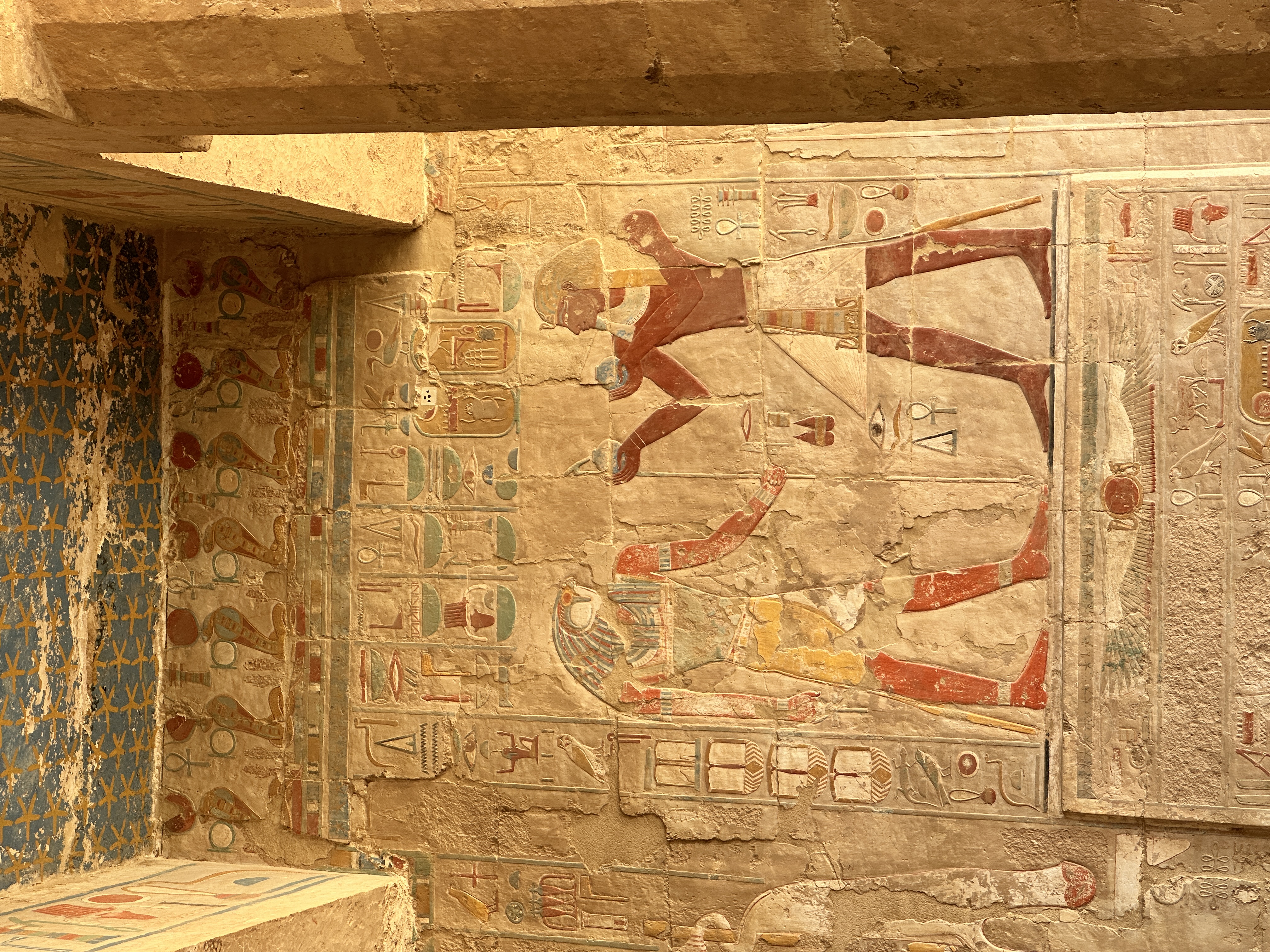
Interesting Fact: Thutmose III, Hatshepsut's nephew and successor, attempted to erase her from history by defacing her images in tombs and monuments. Despite his efforts, her legacy has survived, and she is now remembered as one of the most influential and successful women in Egyptian history.
The Temple of Hatshepsut is regarded as a masterpiece of ancient architecture. Its three massive terraces rise above the desert floor and into the cliffs of Deir el-Bahari. Her tomb lies within the same massif, capped by El Qurn, a pyramid that forms part of her mortuary complex. The temple is decorated with scenes from Hatshepsut's life, reign, and religious scenes. The most famous scene in the temple is the Punt Relief, which depicts Hatshepsut's expedition to the Land of Punt.
Alabaster Stoneworks Artisans
 Several stonework schools and museums are scattered throughout Luxor, showcasing to tourists how the ancient Egyptians crafted their artistry with various stones. We visited one of the schools, Abu Haggag, which aims to keep the tradition of carving alabaster alive through an apprentice program.
Important Note: Prices of handcrafts are often inflated in Egypt because they expect you to haggle. Don't be afraid to negotiate the price down significantly from the initial offer.
The students and teachers were eager to showcase their craft and display their finished products. I was surprised to see that the piece to be carved was placed in the ground while the artist used a special tool to shape the interior. We were impressed with their work and bought two small Pyramids as souvenirs.